Imagine a potential customer searching for your business on Google. They find your listing in the map pack, tap your phone number, and it is wrong. Or they find your address on Yelp, follow it, and arrive at your old location. You have lost that customer. Not because of your service, not because of your pricing, but because of three pieces of information you forgot to keep consistent online.
This is the real-world impact of poor NAP consistency, and it is one of the most overlooked local SEO factors that businesses of all sizes get wrong. In 2026, with Google Maps competition fiercer than ever and AI-powered search engines like Gemini and Perplexity pulling business data from across the web, getting your NAP right is no longer optional.
In this guide, we explain exactly what NAP consistency means, why Google cares so deeply about it, how inconsistencies are silently damaging your local rankings, and, most importantly, how to find and fix them.
What Does NAP Stand For?
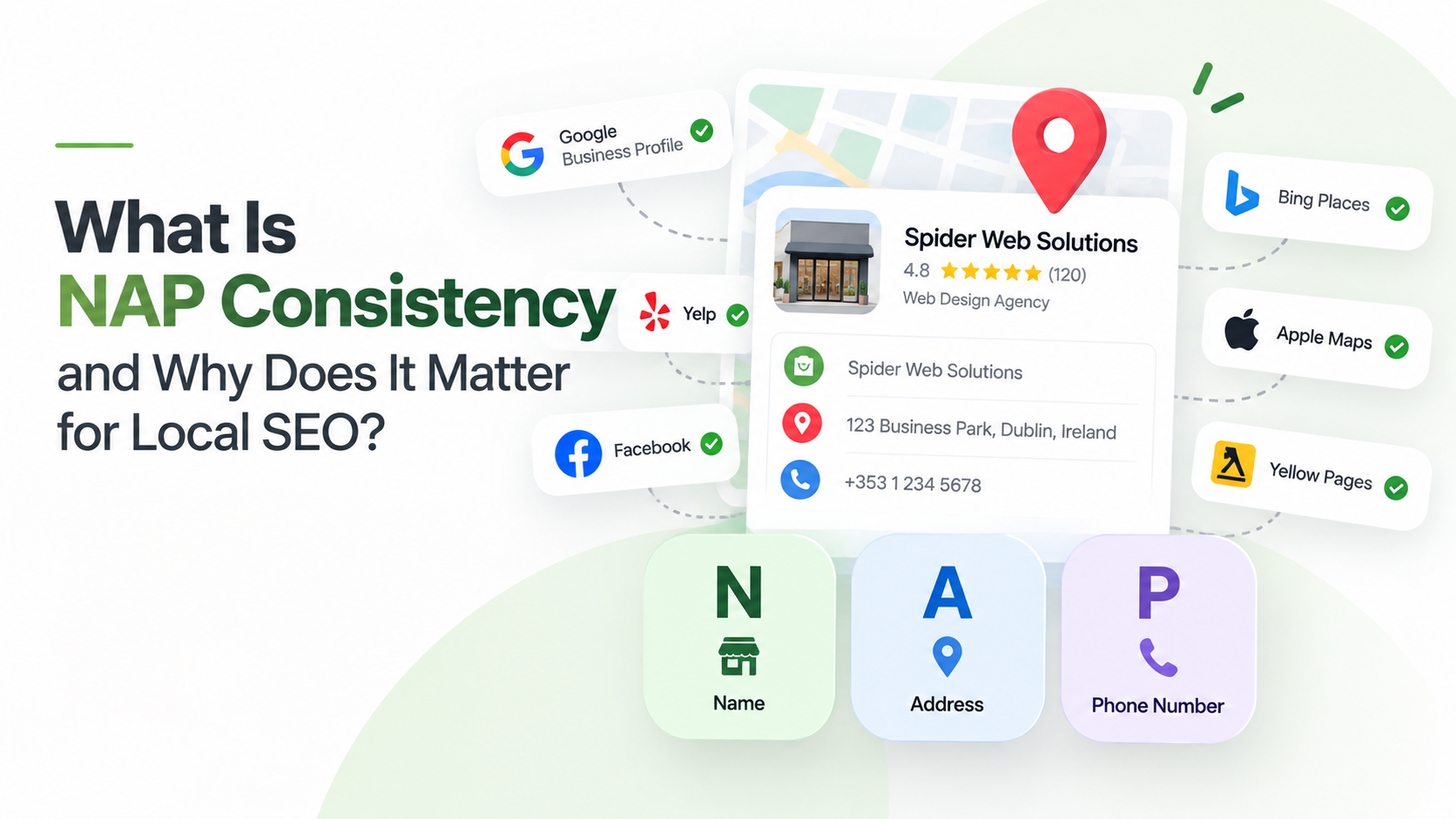
NAP stands for Name, Address, and Phone Number, the three core pieces of information that define your business’s identity across the internet. When SEO professionals talk about NAP consistency, they mean ensuring these three details are presented the same way on every single platform where your business appears online.
You will sometimes also see the term NAP+W, which adds your Website URL as a fourth element. In local SEO, your NAP information is the foundation of your entire online presence, it tells search engines and customers who you are, where you are, and how to reach you.
Here is a simple example of what consistent NAP looks like:
- Name: Spider Web Solutions
- Address: 123 Business Park, Dublin, Ireland
- Phone: +353 1 234 5678
NAP consistency means that exact same information, the same spelling, the same format, the same phone number, appears on your Google Business Profile, your website, Yelp, Facebook, Bing Places, Apple Maps, and every other directory or platform where your business is listed. Even small differences between platforms can create problems.
Why Does Google Care About NAP Consistency?
To understand why NAP consistency matters so much, you need to understand how Google evaluates local businesses. When someone searches for a service near them, say “web design agency near me”, Google does not just look at your website. It cross-references your business information across dozens of sources: your Google Business Profile, your website, major directories, social media profiles, review platforms, and data aggregators.
Google is essentially asking: does this business exist in the real world, and can I trust the information I am seeing? When it finds the same Name, Address, and Phone Number consistently across multiple trusted sources, it gains confidence in your business’s legitimacy and rewards you with better local visibility.
When it finds conflicting information, a different phone number on Yelp, an old address on Yellow Pages, a shortened business name on Facebook, it becomes uncertain. And an uncertain Google is a Google that ranks you lower.
According to the Whitespark 2026 Local Search Ranking Factors report, citation signals including NAP consistency remain among the top five factors for local pack rankings. Businesses with consistent NAP information are 40% more likely to appear in Google’s Local Pack, the coveted map results that appear at the top of local searches. Maintaining strong NAP consistency can boost local search visibility by up to 25% and referral traffic by 15%.
It is also worth noting that this goes beyond just Google. In 2026, AI-powered search engines including ChatGPT, Gemini, and Perplexity pull business information from multiple sources across the web when generating local recommendations. Inconsistent NAP data confuses these systems and reduces the likelihood of your business being recommended in AI-generated responses.
How NAP Inconsistency Hurts Your Local Rankings
The damage that NAP inconsistency causes is often invisible, it happens gradually, silently, in the background, while businesses wonder why their local rankings are not improving despite their other SEO efforts.
Here is how it plays out in practice. Suppose your business moved to a new address two years ago. You updated your Google Business Profile and your website, but you forgot about the 30 other directories where your old address is still live. Google finds your new address on your GBP and website, but your old address on Yelp, Yellow Pages, and a dozen other directories. It now has conflicting signals about where your business actually is. Your proximity relevance for local searches suffers, and your map pack rankings drop.
Or consider a simpler example. Your business is listed as “Spider Web Solutions Ltd” on your website but “Spider Web Solutions” on Google Business Profile and “SpiderWeb Solutions” on Facebook. To a human, these all look like the same business. But to search engine algorithms, these are three different entities, and that fragmentation dilutes your local authority.
The impact extends beyond rankings too. Research shows that 80% of consumers lose trust in a business when they encounter inconsistent contact information online. A customer who finds three different phone numbers for your business across different platforms will not call any of them, they will move on to a competitor.
Where Does Your NAP Information Appear Online?
Most business owners are surprised by just how many places their NAP information appears across the internet. Here are the most important ones to keep consistent:
- Google Business Profile, the single most important listing for local SEO and the first place you should get right
- Your own website, header, footer, contact page, and About page should all display identical NAP information
- Bing Places for Business, Microsoft’s local search platform, often overlooked but important
- Apple Maps, essential for capturing iPhone users searching for local businesses
- Facebook Business Page, one of the most visited sources for business contact information
- Yelp, TripAdvisor, Trustpilot, and review platforms relevant to your industry
- Data aggregators, companies like Data Axle, Foursquare, and Neustar Localeze that distribute your business data to hundreds of downstream directories automatically
- LinkedIn company page and other social media profiles
- Industry-specific directories relevant to your niche
- News articles, press mentions, and third-party websites that reference your business
The data aggregators deserve special attention because they are the least visible but most impactful source of NAP inconsistencies. If your information is incorrect in one data aggregator’s database, that incorrect data can spread automatically to hundreds of other directories, creating inconsistencies at scale that are very difficult to untangle.
Common NAP Inconsistency Mistakes Businesses Make
Understanding the most common mistakes helps you avoid them and spot them faster during an audit:
Abbreviation Inconsistencies
Using “Street” on one platform and “St.” on another, or “Limited” on your website and “Ltd” on Google Business Profile. It is important to note that modern search engines are generally smart enough to understand that “St” and “Street” mean the same thing. What matters far more is accuracy in the core details, especially your actual address number, phone number, and business name, rather than obsessing over punctuation and abbreviation formatting.
Outdated Information After Moving or Rebranding
This is the most damaging and most common mistake. When a business moves premises or changes its phone number, owners typically update their website and Google Business Profile, but forget about the dozens of directories where the old information is still live. These outdated listings continue to send conflicting signals for months or years.
Multiple Google Business Profile Listings
Duplicate GBP listings, which can appear when a previous owner created a listing, or when Google auto-generates one, are a serious local SEO problem. They split your reviews, confuse customers, and dilute your local authority. If you find a duplicate listing for your business, request its removal through Google Business Profile support immediately.
Inconsistent Business Name Formats
Using your full legal business name on some platforms and a trading name or shortened version on others. Decide on one official format for your business name and use it everywhere, consistently.
Forgetting Social Media Profiles
Many businesses update their primary listings but forget to update their LinkedIn, Instagram, Twitter/X, and other social profiles. These platforms are crawled by search engines and contribute to your overall NAP signal across the web.
How to Audit Your NAP Consistency
Before you can fix NAP inconsistencies, you need to find them. Here is a step-by-step process to audit your NAP consistency:
- Establish your master NAP. Decide on the exact, official format of your business name, address, and phone number. Write it down. This becomes your reference point for everything else.
- Google your business name. Look at every listing that appears in the search results and check each one against your master NAP. Note any differences.
- Check major directories manually. Visit Google Business Profile, Bing Places, Apple Maps, Yelp, Facebook, and any industry-specific directories relevant to your business.
- Use NAP audit tools. Tools like Moz Local, BrightLocal, and Semrush’s Listing Management tool can automatically scan hundreds of directories and identify inconsistencies in minutes, saving hours of manual checking.
Document everything in a spreadsheet. Create a simple spreadsheet with columns for the platform name, current NAP shown, what needs to be changed, and whether it has been fixed. Work through it systematically.
How to Fix NAP Inconsistency Step by Step
Once you have identified the inconsistencies, fixing them follows a clear priority order:
Step 1: Perfect Your Google Business Profile First
Your Google Business Profile is the single most important citation for local SEO. Make sure your business name, address, phone number, website URL, opening hours, and business category are all completely accurate. This is your master reference, everything else should match it.
Step 2: Update Your Own Website
Check your website header, footer, contact page, and About page. All of these should display the exact same NAP information as your Google Business Profile. Adding your NAP in structured Schema markup (LocalBusiness schema) also helps search engines read and validate your information more effectively.
Step 3: Fix Priority Directories
Work through your high-authority directories first, Bing Places, Apple Maps, Facebook, Yelp, and Trustpilot. Claim any unclaimed listings, correct any wrong information, and remove any duplicate listings you find. Prioritise the platforms with the highest domain authority as these carry the strongest citation signals.
Step 4: Address Data Aggregators
Submitting correct information directly to the major data aggregators, Data Axle, Foursquare, and Neustar Localeze, can automatically correct downstream inconsistencies across hundreds of directories that pull data from these sources. This is one of the most efficient fixes available.
Step 5: Be Patient
Citation data takes time to propagate across the web. Expect four to twelve weeks for major corrections to be fully reflected in your local rankings. Continue building new, consistent citations during this period to reinforce your positive signals.
How to Keep Your NAP Consistent Going Forward
Fixing your NAP is only half the job. Keeping it consistent going forward requires a simple but disciplined process:
- Create and save a master NAP document, a single document that contains your exact, official business name, address, and phone number. Share it with anyone who manages your online presence.
- Update all platforms simultaneously, whenever any detail changes (new phone number, new address, rebrand), update every platform at the same time, not one by one over weeks.
- Set a quarterly audit reminder, schedule a regular check every three months to catch any inconsistencies that may have appeared due to user-suggested edits, data aggregator errors, or new directory listings.
- Monitor your Google Business Profile for suggested edits, Google allows anyone to suggest changes to your GBP listing. Check your profile regularly to ensure no unauthorised changes have been accepted.
Is Your NAP Consistent Across the Web?
NAP consistency is one of the simplest local SEO wins available to any business, but it is also one of the most commonly neglected. The good news is that once you fix it, it keeps working for you in the background, building Google’s trust in your business day after day.
If you are not sure whether your NAP is consistent across the web, or if you already know it needs attention but are not sure where to start, Spider Web Solutions can help. As a Google Partner agency with over 15+ years of experience helping businesses grow online, we offer comprehensive local SEO audits that identify every NAP inconsistency affecting your rankings, and we fix them for you.
Whether you need a full local SEO strategy, a website that supports your local rankings, or a one-off citation audit, our team is ready to help. Get in touch with Spider Web Solve today and let us make sure your business is found, accurately, consistently, and every time.