Have you ever wondered why some websites consistently rank at the top of Google, even when they don’t seem to have more content or more backlinks than their competitors? The answer often comes down to one thing: E-E-A-T. It is the framework Google uses to evaluate whether your website deserves to rank, and in 2026, it has never been more important.
With AI-generated content flooding the web and Google’s algorithm becoming increasingly sophisticated, E-E-A-T has shifted from a background quality signal to what many SEO experts are now calling a gatekeeper. In the words of one industry analyst: “In 2026, E-E-A-T is not a guideline, it is a gatekeeper. Content without visible experience, ownership, and trust signals will increasingly struggle to compete, no matter how well it is optimised.”
In this article, we break down exactly what E-E-A-T means, why Google cares about it so deeply, and most importantly, what your business can do right now to strengthen these signals and grow your online visibility.
What Does E-E-A-T Stand For?
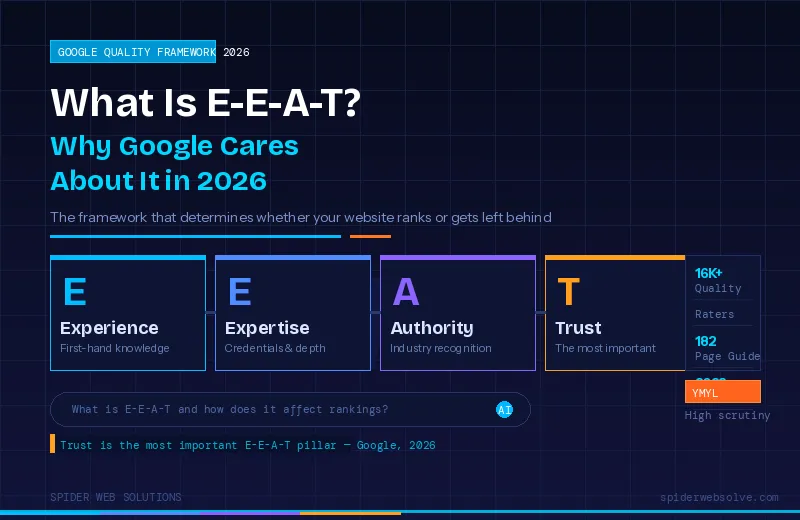
E-E-A-T stands for Experience, Expertise, Authoritativeness, and Trustworthiness. It is a framework that comes directly from Google’s Search Quality Rater Guidelines, a 182-page document that Google uses to train its human quality raters, who in turn help train Google’s ranking algorithms.
The original framework was E-A-T (Expertise, Authoritativeness, Trustworthiness), first introduced publicly in 2015. In December 2022, Google made a significant addition, a second “E” for Experience, formally expanding the framework to E-E-A-T. This change reflected Google’s growing recognition that first-hand, real-world experience with a topic is a quality signal that expertise alone cannot capture.
Here is what each pillar means in plain language:
Experience
Does the content creator have genuine, first-hand involvement with the topic? A financial advisor has expertise in money management, but someone who has personally navigated a complex investment situation has experience. Google wants to see content that could only have been written by someone who has actually done the thing they are describing. Specific details, original outcomes, real examples, and documented processes are all signals of genuine experience.
Expertise
Does the author or website demonstrate genuine knowledge, qualifications, or demonstrated competence in the subject area? Expertise is about depth, the ability to cover a topic thoroughly, accurately, and with nuance. For some topics (particularly medical, legal, and financial content), formal qualifications matter. For others, demonstrated knowledge through consistently high-quality content is sufficient.
Authoritativeness
Is your website and its authors recognised as authoritative sources within your industry? Authority is built over time through backlinks from respected publications, brand mentions, guest contributions to industry platforms, press coverage, speaking engagements, and recognition from peers. It is essentially your reputation in the digital world, and like real-world reputation, it cannot be faked.
Trustworthiness
According to Google’s own documentation, Trust is actually the most important of the four pillars, the one that holds everything else together. A website that lacks trustworthiness cannot compensate with expertise or authority. Trust signals include a secure HTTPS connection, transparent contact information, clear authorship, accurate and up-to-date content, genuine customer reviews, a well-rounded About page, and consistent brand identity across the web.
Is E-E-A-T a Direct Google Ranking Factor?
This is one of the most common misconceptions in SEO, so it is worth being very clear: E-E-A-T is not a direct ranking factor. There is no “E-E-A-T score” that Google calculates and plugs into its algorithm.
What E-E-A-T actually is, is a quality framework used by Google’s approximately 16,000 human Quality Raters worldwide. These raters evaluate search results against the E-E-A-T criteria, and their collective assessments feed into the training data that shapes Google’s ranking algorithms over time. Think of it as a quality compass rather than a ranking lever, it does not directly move your rankings, but it describes the qualities that Google’s systems are designed to detect and reward.
The practical result is the same: websites and pages that demonstrate strong E-E-A-T signals consistently perform better in search results, get cited more frequently in Google AI Overviews, and prove more resilient when core updates roll out.
Why Is E-E-A-T More Critical Than Ever in 2026?
E-E-A-T has always mattered, but 2026 has elevated it to a completely different level of importance. Here is why:
The AI Content Flood
The widespread availability of AI writing tools has led to an unprecedented volume of low-quality, generic content being published across the web. Google’s spam updates throughout 2025 and 2026 have specifically targeted scaled content abuse, mass-produced AI content designed to rank rather than to genuinely help readers. E-E-A-T signals are now Google’s primary tool for separating genuine human expertise from AI-generated noise.
The March 2026 Core Update
The March 2026 Core Update was described by industry analysts as the most volatile update in Google’s history, moving 79.5% of top-3 search positions according to SE Ranking. One of its clearest patterns was a strong amplification of Experience signals, sites with named authors, verifiable credentials, original research, and first-person case studies gained significant ground, while unattributed, generic content lost rankings. Sites with original data saw a 22% visibility increase post-March 2026, while AI-paraphrased content lost up to 71% of its traffic.
Google AI Overviews Prefer High E-E-A-T Sources
As Google AI Overviews now appear in roughly 58% of all searches, being cited as a source within these AI-generated summaries has become a significant visibility opportunity. Google’s AI systems heavily favour high E-E-A-T content when selecting sources, meaning that businesses with strong trust and authority signals are far more likely to appear in AI Overviews than those without.
Which Websites Need E-E-A-T the Most?
Google applies the highest E-E-A-T scrutiny to what it calls YMYL content. Your Money or Your Life. These are topics where inaccurate or low-quality information could have a serious negative impact on a reader’s health, financial wellbeing, safety, or happiness.
YMYL categories include health and medical information, financial advice and investment guidance, legal information, news and current events, and, as of the September 2025 Quality Rater Guidelines update, government, civics, and society content.
That said, every business benefits from strong E-E-A-T signals, not just those in YMYL categories. Whether you run an e-commerce store, a local service business, or a digital marketing agency, your website’s credibility, trustworthiness, and demonstrated expertise directly influence how Google evaluates your content relative to competitors.
How to Improve Your E-E-A-T in 2026: Practical Steps
The good news is that improving your E-E-A-T is not about technical tricks or shortcuts, it is about genuinely building a more credible, trustworthy online presence. Here is how to do it:
1. Add Detailed Author Bios to All Content
Publishing content under a generic “Admin” username is a significant E-E-A-T weakness. Every piece of content on your website should be attributed to a named author with a detailed bio that includes their credentials, professional background, areas of expertise, and links to their professional profiles (LinkedIn, industry publications they have contributed to). Author bios are no longer optional metadata, they are now ranking infrastructure.
2. Showcase Real Client Results and Case Studies
Nothing demonstrates genuine experience more powerfully than documented results. Case studies that show real client challenges, the approach your team took, and the measurable outcomes achieved are exactly the kind of first-hand, specific content that Google’s Experience signals reward. Generic claims about being “the best” or “industry leaders” carry no weight, specific results do.
3. Build a Strong, Transparent About Page
Your About page is one of the most important trust signals on your website. It should clearly explain who you are, how long you have been in business, what your team’s background is, and why customers can trust you. Include your physical address, contact details, company registration information if relevant, and any certifications or partnerships that add credibility, such as being a Google Partner agency.
4. Earn Quality Backlinks and Brand Mentions
Authoritativeness is built externally, through how other reputable websites reference and link to you. Focus on earning backlinks from genuinely relevant, high-quality publications in your industry. Guest contributions to respected industry blogs, press mentions, and being featured in industry roundups all contribute to authority. A handful of strong, relevant backlinks from trusted sources are worth far more than dozens of links from low-quality directories.
5. Collect and Display Genuine Reviews
Trustworthiness is heavily influenced by what your customers say about you on third-party platforms. Actively encourage satisfied clients to leave reviews on Google Business Profile, Trustpilot, Clutch, or other industry-relevant review platforms. Display these reviews prominently on your website. Consistent, positive reviews from real clients are one of the strongest trust signals available to any business.
6. Keep Your Content Accurate and Up to Date
Content freshness is now considered one of the most important ranking factors, with pages updated within the last year gaining an average of 4.6 ranking positions according to recent research. Outdated information is a direct trust signal problem. Conduct regular content audits, add “Last Updated” dates to key pages, refresh statistics with current data, and ensure all recommendations reflect the current state of your industry.
7. Cite Credible Sources in Your Content
Supporting your claims with links to authoritative, credible external sources, official research, government data, industry reports, and reputable publications, signals to both readers and Google that your content is grounded in verified information rather than opinion or assumption.
Common E-E-A-T Mistakes Businesses Make
Understanding what to do is just as important as knowing what to avoid. Here are the most common E-E-A-T mistakes that businesses make, and that Google consistently penalises:
- Publishing content without author attribution, anonymous content has no visible expertise behind it and scores poorly with quality raters
- Having a thin or missing About page. Google needs to understand who is behind your website to assess trustworthiness
- Ignoring online reviews, a business with no reviews or unmanaged negative reviews signals low trustworthiness
- Publishing AI-generated content without genuine editorial review, generic AI content lacks the experiential depth Google now prioritises
- Never updating old blog posts, outdated content signals a lack of care and accuracy, particularly for fast-moving topics
- Covering topics outside your genuine area of expertise, trying to rank for everything dilutes your topical authority
Is Your Website Built on a Strong E-E-A-T Foundation?
E-E-A-T is no longer a background consideration for SEO professionals. In 2026, it is the central quality framework that determines whether your website competes, or gets left behind. The businesses that are winning in search right now are not just the ones with the most content or the most backlinks. They are the ones that have built genuine credibility, demonstrated real expertise, and earned the trust of both their audience and Google.
At Spider Web Solutions, we help businesses of all sizes build the kind of digital presence that Google rewards. Whether you need a full SEO audit to identify E-E-A-T gaps on your website, a content strategy designed to showcase your genuine expertise, or a web design overhaul that strengthens trust signals from the ground up, our team of digital marketing experts is ready to help.
Get in touch with Spider Web Solutions today and let us help you build a website that Google trusts, and that your customers trust too.