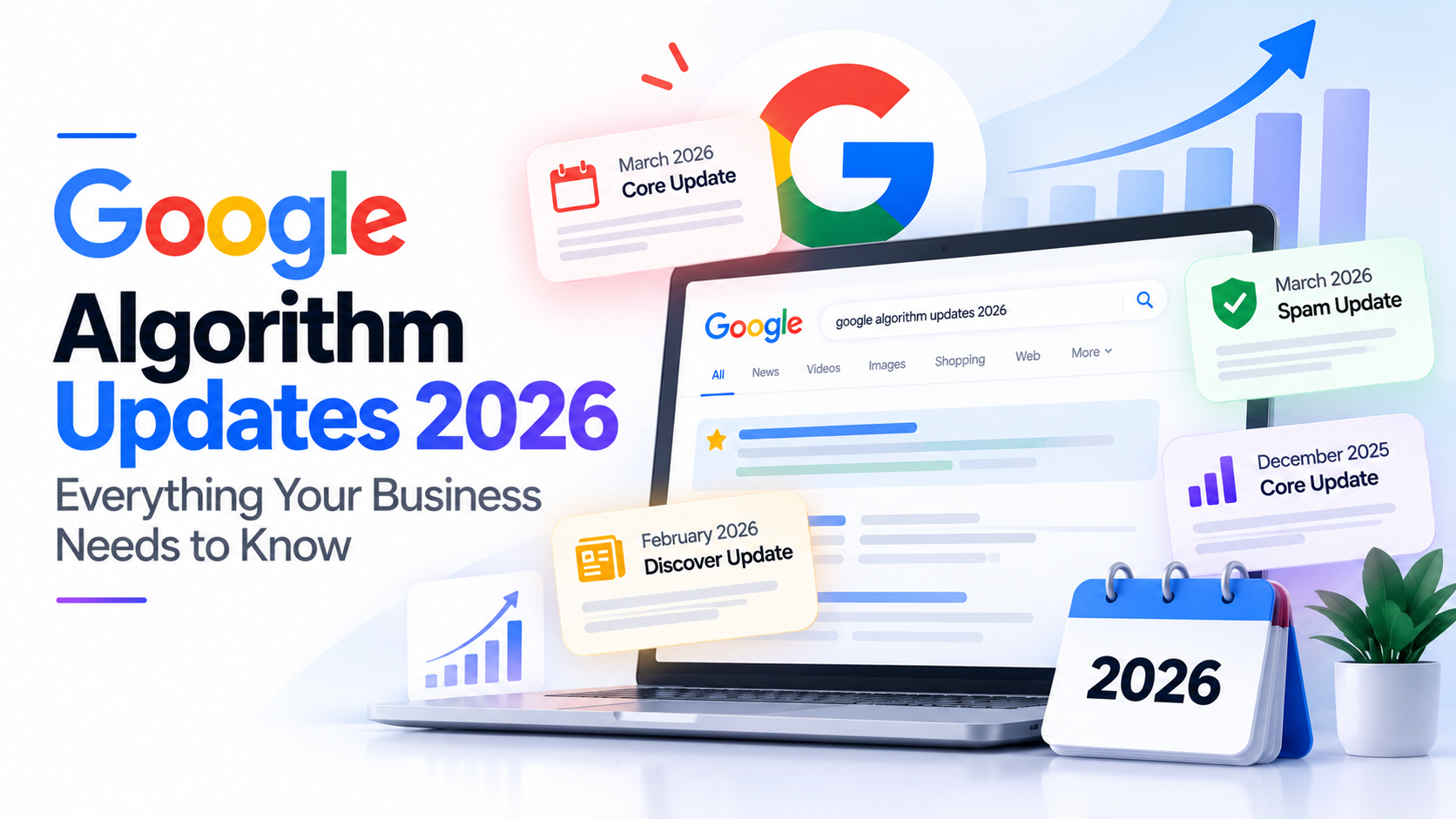
If you’ve noticed shifts in your website traffic or search rankings over the past few months, you’re not imagining things. Google has been unusually active in 2026, rolling out a wave of significant algorithm updates that have reshuffled search results across almost every industry. Whether you’re a business owner, a marketer, or an SEO professional, understanding what changed, and why, is the first step to staying ahead.
In this article, we break down every major Google update from 2025 into 2026, explain what each one targeted, and, most importantly, tell you what your business should do about it.
What Is a Google Core Update, and Why Does It Matter?
Before diving into the specific updates, it helps to understand what Google actually means by a “core update.” Several times a year, Google makes broad, significant changes to the way it ranks websites across all search results globally. These aren’t small tweaks to a single ranking factor, they are wide-scale reassessments of how Google evaluates the overall quality, relevance, and helpfulness of web content.
According to Google’s own documentation, core updates are designed to ensure that “overall, we’re delivering on our mission to present helpful and reliable results for searchers.” In other words, Google is constantly asking itself: are the pages we’re ranking at the top actually the best answer for a user’s query? When the answer is “not quite,” a core update happens.
The important thing to understand is that these updates don’t penalise websites directly. A site that drops in rankings after a core update hasn’t done anything wrong, it simply means that other pages are now being evaluated as more relevant or more helpful. It’s a rising tide, not a punishment.
The Major Google Updates of 2025–2026: A Complete Breakdown
1. March 2026 Core Update (Launched: March 27, 2026)
This is the most recent and most significant update to watch right now. Launched on March 27, 2026, the March Core Update affects search results globally and is expected to take up to two weeks to fully roll out. Many webmasters and SEO professionals have already reported noticeable ranking volatility across multiple niches.
What to watch: If you saw traffic changes in late March or early April 2026, this update is very likely the cause. Wait for the rollout to complete fully before drawing conclusions and making changes to your site. Knee-jerk reactions to mid-rollout volatility often do more harm than good.
2. March 2026 Spam Update (Launched: March 24, 2026)
Just three days before the Core Update, Google rolled out a spam update targeting manipulative and low-quality content practices. While early reports suggest this update felt relatively muted in impact, industry analysts believe it may be signalling larger algorithmic shifts on the horizon, particularly around content farms, manipulative link patterns, and AI-generated content designed solely to game search results.
What to watch: If your site relies heavily on automated content or thin pages stuffed with keywords, this update, and the ones that likely follow, are a direct warning signal.
3. February 2026 Discover Core Update (Launched: February 5, 2026)
This update was unique because it targeted Google Discover, the personalised content feed on Android and iOS devices, rather than traditional search results. It started on February 5 for English-language users in the US before expanding to other countries and languages.
The impact was notable: data analysis showed that the update resulted in fewer domains appearing in US Discover feeds, with local and smaller publishers appearing to lose reach. Google also revised its Discover guidelines alongside this update, placing more emphasis on content that is timely, engaging, and genuinely interesting to the end reader, not content engineered purely for clicks.
What to watch: If you track Google Discover as a traffic source and noticed a drop in early February, this update is the culprit. Review your Discover-facing content for genuine reader value.
4. December 2025 Core Update (Launched: December 11, 2025)
The December 2025 Core Update ran for 18 days, completing on December 29. One of the more interesting patterns that emerged from this update was that established brands saw gains in “best of” queries, searches like “best CRM software” or “best running shoes” started favouring well-known, authoritative brand names over independent review sites.
Crucially, several case studies emerged showing that sites that had been hit by previous updates were able to recover, but only after making meaningful, sustained improvements to content quality over multiple months.
5. August 2025 Spam Update (Launched: August 26, 2025)
This was a lengthy spam-focused update that took 26 days to complete, finishing on September 21. Google’s spam updates use its AI-powered SpamBrain system to detect and demote a wide range of manipulative tactics, from link schemes and keyword stuffing to cloaking and auto-generated content.
6. June 2025 Core Update (Launched: June 30, 2025)
The June 2025 Core Update completed on July 17, taking over two weeks to fully roll out. Google’s John Mueller offered a notable insight around this time: core updates build on long-term data patterns, meaning that Google’s evaluation of your site is not a snapshot, it is a moving, historical picture of your content’s performance and quality over time.
This is an important mindset shift for anyone trying to “recover” from a core update. There are no quick fixes. Google needs time to observe that your improvements are genuine and sustained.
7. March 2025 Core Update (Launched: March 13, 2025)
Completing on March 27, the March 2025 Core Update took two weeks to roll out and was the first major algorithmic shift of 2025. It reinforced the direction Google had been heading in for the previous two years, rewarding content that demonstrates genuine expertise, real-world experience, and a clear understanding of what the reader actually needs.
The Bigger Picture: What Is Google Actually Rewarding?
Looking across all these updates together, a very clear picture emerges. Google is on a sustained, multi-year mission to surface content that is genuinely useful, not content that is engineered to rank. Here are the core principles that connect every major update over the past two years:
- People-first content wins. Google has consistently rewarded pages written for human readers rather than search engine crawlers. If your primary question when creating content is “will this rank?” instead of “will this genuinely help my audience?”, you’re writing for the wrong boss.
- E-E-A-T is everything. Experience, Expertise, Authoritativeness, and Trustworthiness are the four pillars of Google’s quality evaluator guidelines. In practical terms, this means content that demonstrates real-world knowledge, is written by credible authors, is backed by reputable sources, and lives on a trustworthy website.
- Thin and scaled AI content is under pressure. Google is not anti-AI, but it is firmly anti-low-quality-AI. Content that is generated at scale without genuine editorial input, fact-checking, or original insight is increasingly being filtered out by spam and core updates alike.
- Recovery takes months, not days. Google’s own guidance makes clear that after making improvements, it can take several months for their systems to fully reassess your site. Patience and consistency are not optional, they’re required.
- Technical foundations still matter. While content quality is the dominant theme, sites with poor Core Web Vitals, slow load times, or mobile experience issues continue to face headwinds regardless of how good their content is.
What Should Your Business Do Right Now?
If you’re concerned about how these updates may have affected your website, here is a practical, step-by-step approach:
Step 1: Check Your Search Console Data
Log into Google Search Console and check your Performance report. Compare traffic from the past 3 months against the same period in 2025. Look for drops in impressions and clicks that correlate with the update dates listed above. Pay close attention to which specific pages and queries were most affected, this will tell you where to focus your efforts.
Step 2: Conduct an Honest Content Audit
Look at your most-affected pages and ask yourself honestly: does this page actually help the person searching for it? Does it answer the query fully? Is it based on real knowledge or experience? Is there original insight here that readers can’t find on a hundred other websites? If the honest answer to any of these questions is no, you have your roadmap for improvement.
Step 3: Avoid Quick Fixes
Google explicitly warns against making superficial changes in response to core updates, like removing page elements you heard were “bad for SEO” or rewriting articles to cram in more keywords. These tactics don’t work and can make things worse. Focus instead on changes that would genuinely make your content more useful, readable, and trustworthy for a real human reader.
Step 4: Strengthen Your E-E-A-T Signals
Make sure your website demonstrates credibility and authority. This includes having clear author bios on content-heavy pages, citing authoritative sources, having a well-rounded About page, showcasing client results or case studies, and earning genuine backlinks from reputable websites in your industry.
Step 5: Review Your Technical SEO Foundations
Even the best content won’t perform if your site has technical issues holding it back. Run a Core Web Vitals report in Google Search Console, test your mobile usability, check your page speed on PageSpeed Insights, and make sure Google can properly crawl and index your key pages.
Looking Ahead: What to Expect for the Rest of 2026
Based on the patterns we’ve observed across Google’s updates over the past two years, here is what businesses and marketers should be preparing for:
- More frequent updates. Google has been accelerating the pace of its core and spam updates. The gap between major updates is getting shorter, meaning your SEO strategy needs to be a continuous process, not an annual project.
- Greater scrutiny of AI-generated content. Google will continue to evolve its ability to detect low-quality, scaled AI content. Businesses that rely on AI writing tools should ensure every piece of content is thoroughly reviewed, edited for accuracy, and enriched with genuine human expertise before publishing.
- AI Overviews will grow in importance. Since launching in May 2024, Google’s AI Overviews have expanded globally. Businesses that want to appear in these AI-generated summaries need to focus on earning citations as authoritative sources, which means strong E-E-A-T, clear structure, and factually accurate content.
- Brands will continue to win. The trend of established brands performing better on high-value queries appears to be strengthening. Investing in your brand’s online reputation, online reviews, and digital PR will matter as much as technical SEO in 2026 and beyond.
Is Your Website Ready for Google’s Next Update?
Keeping up with Google’s algorithm changes is a full-time job, and it’s one of the most valuable investments a business can make in its online presence.
The businesses that win in search are not the ones that chase every update; they’re the ones that build websites and content that are genuinely excellent, technically sound, and trusted by their audience.
At Spider Web Solutions, we’ve been helping businesses around the world navigate exactly these challenges for over 10+ years. As a Google Partner agency, we stay at the forefront of every algorithm change so our clients don’t have to worry about falling behind.
Whether you need an SEO audit to understand how recent updates have affected your rankings, a full content strategy overhaul, or technical support to improve your site’s Core Web Vitals, our team is ready to help.
Get in touch with Spider Web Solutions today and let’s make sure your website is built to thrive, not just survive, in 2026 and beyond.
One reply on “Google Algorithm Updates 2026: Everything Your Business Needs to Know”
[…] the modern web protocols that dramatically improve how quickly pages load. Since Google uses Core Web Vitals (including Largest Contentful Paint and Cumulative Layout Shift) as ranking factors, the speed […]