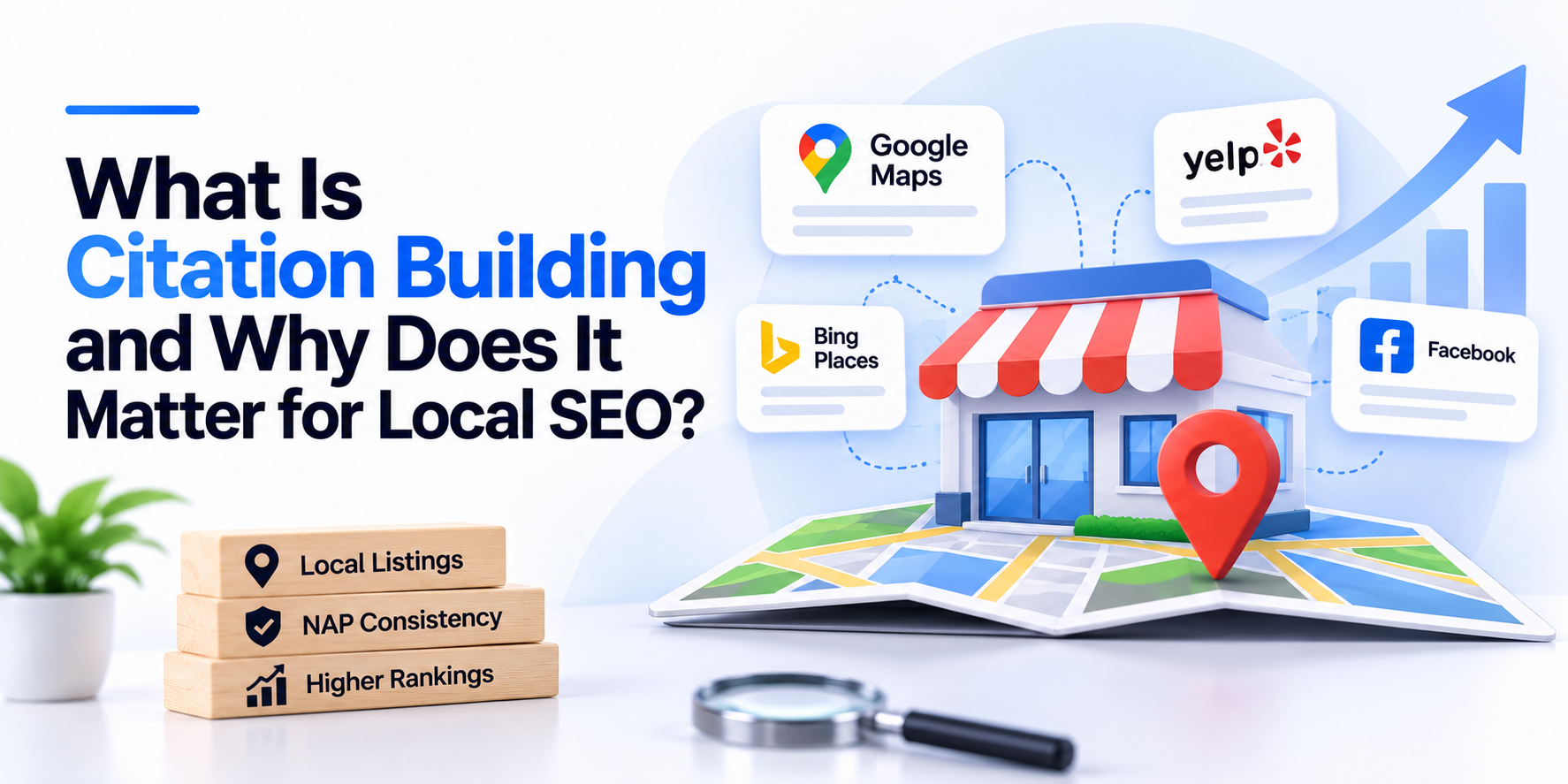
Picture a potential customer searching for a service like yours in their local area. They see three businesses in the map results, each with a complete listing, consistent contact details, and mentions across the web. Your business is out there too, but it is listed with an old phone number on one site, missing from another, and barely mentioned anywhere else. Google has to decide which businesses it trusts enough to recommend, and part of how it decides is by checking what the rest of the internet says about each one.
Those mentions are called local citations, and the process of creating and managing them on purpose is called citation building. It is one of the oldest tasks in local SEO and one of the most misunderstood. Some people call it outdated. Others treat it as the whole game. The honest answer sits somewhere in between, and it has shifted again in 2026 as AI-powered search tools begin recommending local businesses using data pulled from across the web.
In this guide we explain what citations are, why they matter, the different types, how to build them step by step, how many you really need, and the mistakes that quietly undermine the whole effort.
What Is a Local Citation?
A local citation is any online mention of your business’s name, address, and phone number, often shortened to NAP. Sometimes a citation also includes your website address, opening hours, or business category. Crucially, a citation does not need to link to your website to count.
Citations appear in many places: business directories, map platforms, review sites, social media profiles, chamber of commerce pages, local news articles, and blog posts that mention your business.
It helps to separate citations from backlinks, because the two are often confused. A backlink is a link from another website to yours, and its main job is to signal that your website is worth trusting. A citation is a mention of your business details, and its main job is to confirm that your business exists, is real, and operates where it says it does. Some citations include a link, so the two overlap, but a citation works even without one.
Here is a simple example. A local accountant has a Yelp listing showing their firm name, street address, and phone number. That is a citation. So is a local newspaper article that mentions the firm and its phone number in the text, even if the article contains no link at all.
What Is Citation Building?
Citation building is the process of deliberately creating, claiming, and maintaining citations for your business on the platforms that matter. That includes setting up listings on major platforms and relevant directories, correcting inaccurate ones, and earning mentions in local media and community websites.
It is closely related to NAP consistency, but the two are not the same thing. Citation building is about where your business appears online. NAP consistency is about whether the details shown in those places match exactly. You need both, because a perfectly consistent profile that appears almost nowhere is weak, and a widely listed business with conflicting details is confusing. If you want a deeper look at the consistency side, read our guide to NAP consistency and local SEO.
Citation building is also not a one-time job. Businesses move, change phone numbers, rebrand, and add services. Directories merge, close, and get copied by other sites, and duplicate listings appear without warning. Think of it as an ongoing habit rather than a project you finish.
Why Does Citation Building Matter for Local SEO?
Citations matter for three connected reasons, and one important caveat about how much weight they carry.
They Verify That Your Business Is Real
Google does not simply take your word for who you are and where you operate. It cross-checks your details against other sources. When the same information appears on several independent, reputable sites, Google gains confidence that your business is legitimate and located where you say it is. Think of citations as references that confirm your identity.
They Support Prominence
Google describes local ranking through three ideas: relevance, distance, and prominence. Citations contribute mainly to prominence, which reflects how well known and trusted your business appears. A business that is mentioned across many reputable sources looks more established than one that exists only on its own website.
They Feed AI Search
AI tools such as ChatGPT, Gemini, and Perplexity draw on business information from across the web when they recommend local providers. In Whitespark’s 2026 Local Search Ranking Factors survey of 47 local SEO specialists, citation signals stayed roughly flat for traditional map pack rankings but rose to around 13% of the factors that influence AI search visibility. Accurate citations help these systems find you and recommend you with confidence.
An Honest Note on How Much They Weigh
Citations are not the biggest lever in local SEO, and it would be misleading to suggest otherwise. In the same 2026 survey, on-page signals were the largest single category of influence for local organic results, at around 33%, and your Google Business Profile and reviews carry heavy weight as well. In earlier surveys, citation signals made up roughly 7% of ranking influence.
The sensible way to see them is as a foundation. Strong citations rarely win rankings on their own, but missing, inaccurate, or conflicting ones can hold back everything else you do.
Structured vs Unstructured Citations
Not all citations look the same. They fall into two broad types, and a healthy profile needs both.
Structured Citations
Structured citations are listings with set fields, such as a field for your name, a field for your address, and a field for your phone number. Examples include your Google Business Profile, Bing Places, Apple Maps, Facebook, Yelp, and industry directories. Your Google Business Profile is itself your most important structured citation, which is why getting it right comes first. These citations are the easiest to create and control.
Unstructured Citations
Unstructured citations are mentions of your business in free-form text: news articles, local blog posts, press releases, event pages, podcast show notes, sponsor pages, and community websites. You cannot fill in a form to get one. You have to earn them. They carry real credibility because someone chose to mention you.
Why You Need Both
Structured citations give you coverage and consistency. Unstructured citations give you credibility and show real-world recognition. Together they tell Google, and AI search tools, that your business is both clearly defined and genuinely known in its community.
Types of Citation Sources
Knowing where citations come from helps you prioritise. Here are the main categories:
- Major platforms: Google Business Profile, Bing Places, and Apple Maps (managed through Apple Business Connect). These reach the largest audiences and should always come first.
- Data aggregators: Companies that collect business data and distribute it to many directories, apps, and navigation systems. In the US, major aggregators include Data Axle and Foursquare, and other countries have their own equivalents. Correct data at this level can flow down to many smaller sites.
- General directories: Broad listing sites such as Yelp, Yellow Pages, and Facebook that cover businesses of every kind.
- Industry-specific directories: Sites that serve one sector, such as legal directories, healthcare directories, home services platforms, or agency directories like Clutch. These carry strong relevance signals.
- Local and regional sources: Chamber of commerce pages, local business associations, regional council websites, and local news outlets.
- Social and review platforms: LinkedIn, Instagram, Trustpilot, and other platforms where your business details appear alongside customer feedback.
How to Build Local Citations Step by Step
Here is a practical process that works for most businesses:
- Finalise your master business information. Decide on the exact version of your business name, address, phone number, website, categories, opening hours, and description. Write it down in one document. Every listing you create should be copied from this source.
- Audit your existing citations. Search for your business name, your phone number, and any old addresses to see what already exists. Tools such as BrightLocal, Moz Local, and Semrush can scan many directories at once. Look for duplicates and wrong details, and fix those before building anything new. Adding fresh listings on top of messy data only multiplies the problem.
- Claim and complete the major platforms first. Start with your Google Business Profile, then Bing Places, Apple Business Connect, and Facebook. Fill in every field, add photos, and choose categories carefully.
- Submit to data aggregators where relevant. If you operate in a market where aggregators matter, such as the US, confirm that your details are correct with them so accurate data spreads downstream.
- Add listings on relevant industry and local directories. Choose directories that your customers actually use and that fit your sector and location. One relevant directory is worth more than ten random ones.
- Earn unstructured citations. Sponsor a local event, share news with local journalists, join business associations, take part in community projects, contribute guest articles, and ask partners or suppliers to list you on their websites.
- Track everything. Keep a simple spreadsheet recording each platform, the listing URL, the date added, the details used, and the login. Review it every quarter so changes and new duplicates are caught early.
How Many Citations Do You Need?
There is no magic number, and chasing a high count is one of the most common mistakes. Quality and relevance matter far more than volume. Submitting your business to hundreds of low-quality directories adds clutter, creates duplicates, and can cause more harm than good.
A better approach is to benchmark against your top three local competitors. Use a tool such as BrightLocal or Whitespark’s Local Citation Finder to see where they are listed. Then look for relevant sites where they appear and you do not, and prioritise those. Once you have matched the quality and coverage of the businesses you are competing with, adding more brings diminishing returns. Your effort is better spent on reviews, your Google Business Profile, and the content on your website.
How Long Does Citation Building Take to Work?
Timelines vary. Many directories publish new listings within a few days, while others take weeks, and verification steps such as postcards or phone calls can add delays. Corrections made at the data aggregator level can take longer to spread across the sites that pull from them.
Ranking improvements are gradual. Expect changes to show up over several weeks to a few months, and expect the benefits to build over time as more of the web agrees about who you are. It is a slow-burn tactic, not a quick fix.
To measure progress, watch these signals:
- Google Business Profile performance: calls, direction requests, and website clicks
- Google Search Console: impressions and clicks for local and branded searches
- Local rank tracking: map pack positions across your service area
- Analytics: referral traffic from the directories you have joined
Common Citation Building Mistakes
Most citation problems come from a handful of avoidable errors:
- Using low-quality or spammy directories. Listing sites that exist only to sell links add little value and can look suspicious.
- Creating duplicate listings. Duplicates split your reviews and authority and confuse both customers and search engines.
- Letting details drift out of sync. A new phone number on your website but an old one on three directories sends mixed signals.
- Stuffing keywords into your business name. Adding services or locations to your name breaks the rules of Google Business Profile and can lead to suspension.
- Ignoring industry-specific directories. Niche sources often carry the strongest relevance signals for your sector.
- Building once and never reviewing. Citation data decays as businesses change and directories update, so regular audits matter.
Citation Building in 2026: What Has Changed?
Three shifts define citation building this year.
First, AI search has given citations a second job. Beyond helping Google verify your business, accurate and widespread business data now helps AI assistants decide whether to recommend you. That is why citation signals rose in importance for AI visibility even as their weight for traditional map pack rankings stayed steady.
Second, the emphasis has moved from volume to quality. The old approach of submitting to as many directories as possible has given way to a focused one: get the major platforms right, add the directories that are relevant to your sector and location, and earn genuine mentions.
Third, citations now work as part of a wider system. On-page signals, reviews, your Google Business Profile, and structured data all carry weight alongside them. Adding Local Business schema to your website, for example, gives search engines a clear, machine-readable version of the same details your citations display. The businesses that perform best treat citation building as one part of a complete local SEO strategy, not a standalone tactic.
Is Your Business Easy to Find and Trust Online?
Citation building will not transform your rankings overnight, but it is one of the most dependable foundations in local SEO. Accurate, relevant citations help Google verify your business, help AI tools recommend it, and make it easier for customers to find the right details wherever they look.
At Spider Web Solutions, we help businesses of all sizes strengthen their local visibility. With 15+ years of experience delivering web design and development solutions, and a team of specialists across SEO, PPC, content marketing, and digital strategy, we understand how citations, your Google Business Profile, and your website work together.
Whether you need a citation audit to find duplicates and inconsistencies, help building listings on the platforms that matter, or a wider local SEO strategy, our team is ready to help. Get in touch with Spider Web Solutions today.