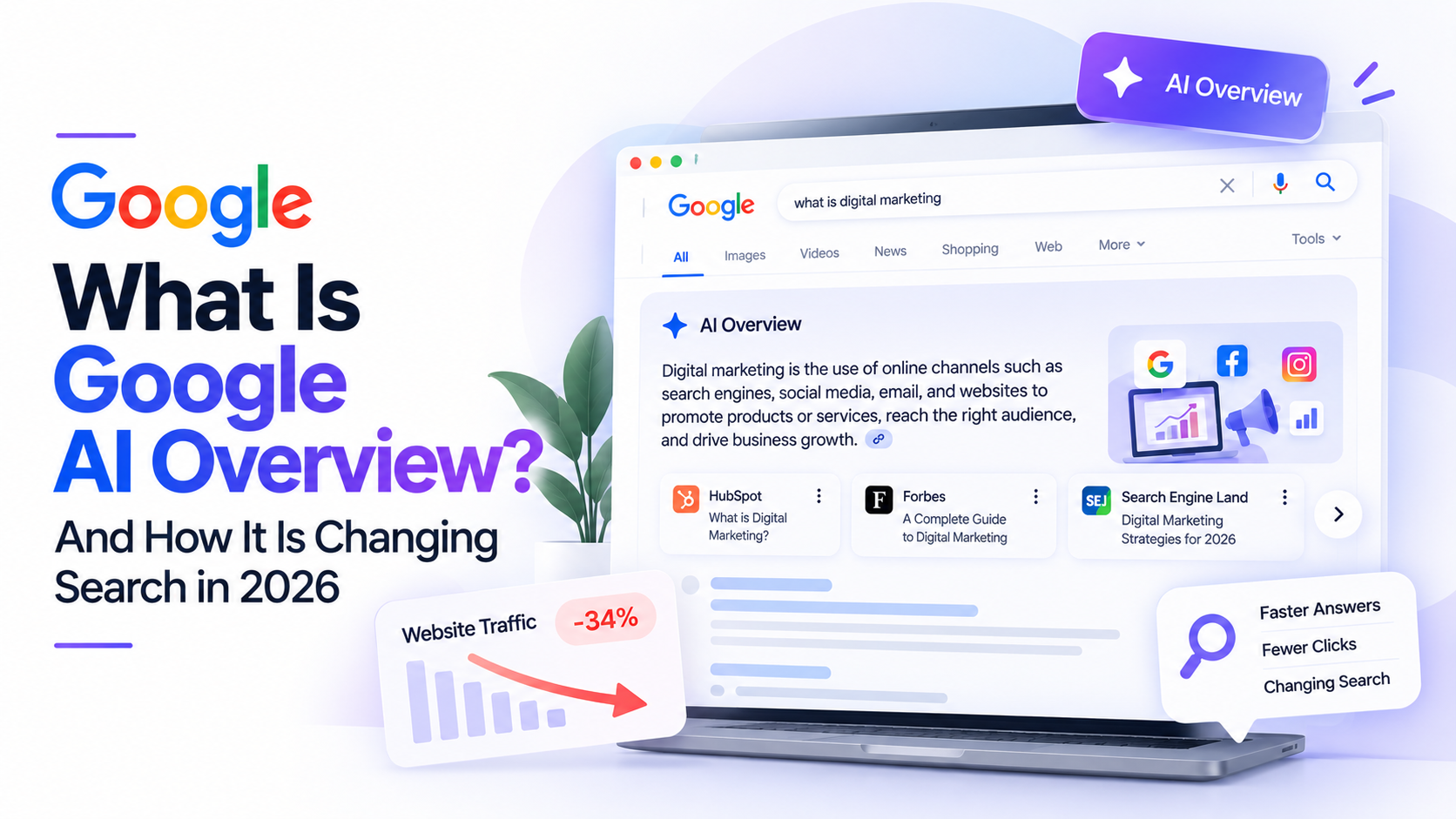
If you have noticed your website traffic quietly declining over the past year despite holding your rankings, you are not alone, and the culprit is almost certainly Google AI Overview. This relatively new feature has fundamentally changed how search results look, how users interact with them, and, most importantly for businesses, whether they click through to websites at all.
Google AI Overview is now one of the most significant shifts in the history of search. Understanding what it is, how it works, and what it means for your business is no longer optional. In this article, we break it all down, clearly, practically, and without the jargon.
What Is Google AI Overview?
Google AI Overview (also referred to as AIO) is an AI-generated summary that appears at the very top of Google search results. When you type a question into Google, instead of simply showing you a list of blue links, Google now often displays a generated answer box first, pulling together information from multiple sources across the web and presenting it as a single, concise response.
These summaries are powered by Gemini, Google’s large language model. As of 2026, Gemini 3 is the default model driving AI Overviews globally. The feature was first introduced as Search Generative Experience (SGE) at Google I/O in May 2023, officially launched in the US in May 2024, and has since expanded to over 200 countries and 40 languages.
The goal, as Google frames it, is to make search faster and more conversational, combining traditional search results with AI-generated understanding to give users direct answers without requiring them to visit multiple websites.
How Does Google AI Overview Work?
When a user submits a search query, Google’s systems assess whether the query is complex or multi-faceted enough to benefit from an AI-generated summary. If the answer is yes, Google AI Overviews kick in, analysing and synthesising content from multiple high-quality web pages to produce a structured answer.
AI Overviews appear most frequently for informational, research-style queries. According to data from seoClarity, over 96% of AI Overviews are triggered by informational user intent, while they appear in transactional queries, those where someone is ready to buy, only about 1.2% of the time. In practical terms, this means queries like “how does X work” or “what is the best way to do Y” are far more likely to generate an AI Overview than “buy X online.”
Longer, more complex searches also trigger Google AI Overviews far more often. Research shows that ten-word queries generate an AI Overview over five times more frequently than single-word searches. As of early 2026, AI Overviews appear in roughly 58% of all Google searches, a figure that has grown dramatically since the feature first launched.
What Has Changed in Google AI Overviews in 2026?
Google has been actively evolving the AI Overview feature throughout 2025 and 2026. Here are the most significant recent developments:
AI Mode Integration
Google has been deepening the connection between AI Overviews and its newer AI Mode experience. On mobile, users who tap “Show more” on an AI Overview are now transitioned into an AI Mode-style experience. As of April 2026, Google is testing this same behaviour on desktop, blurring the line between traditional search and a fully conversational AI interface.
Better Source Visibility and Subscription Links
In early May 2026, Google announced significant updates to how links are displayed within AI Overviews. The search giant introduced a feature that highlights when an AI Overview response contains information from a publication the user subscribes to. Google reported that in early testing, users were significantly more likely to click through to a website when this “Subscribed” label appeared, a move designed partly to address growing publisher concerns about declining referral traffic.
Expanded Link Discovery
Google has also introduced suggestions at the end of many AI responses, pointing users to where they can explore a topic further across the web. This is part of a broader push to position AI Overviews not as the final destination, but as a starting point for deeper exploration.
How Google AI Overviews Are Affecting Website Traffic
This is where things get real for businesses. The impact of Google AI Overviews on organic website traffic is significant, well-documented, and not going away.
As of early 2026, approximately 58% of all Google searches result in zero clicks, meaning users read the AI-generated answer and leave without visiting any website. Studies show that click-through rates for top-ranking pages drop by 34% to 46% when an AI Overview appears above them. Some websites have reported traffic declines of between 20% and 40% since AI Overviews became mainstream.
The impact varies significantly by content type. Informational content, blog posts, how-to guides, explainer articles, is most heavily affected because these are exactly the query types that trigger Google AI Overviews most often. Transactional and local content faces considerably less disruption. Research shows AI Overviews appear for only about 7% of local search queries, which means businesses targeting location-specific terms like “web design agency in UAE” are relatively protected compared to those targeting broad informational terms.
Which Industries Are Most Affected?
Not all industries are equally impacted by Google AI Overview. The sectors that rely most heavily on informational content to drive traffic have felt the sharpest drops:
- Publishing, news, and media, among the hardest hit, with some publishers reporting referral traffic drops of 25% to 55%
- Health and wellness content, heavily affected due to the informational nature of most health queries
- Finance and legal information, high-volume informational queries now frequently answered by AI
- Digital marketing and SEO, the very industry writing about AI Overviews is also navigating their impact
Businesses in e-commerce, local services, and professional services with strong brand recognition are somewhat better insulated. Gartner projects that by the end of 2026, 25% of organic search traffic overall will shift to AI chatbots and voice assistants, making adaptation a business priority, not just an SEO concern.
How to Optimise Your Business for Google AI Overview
The good news is that Google AI Overviews are not just a threat, they are also an opportunity. Appearing as a cited source within an AI Overview delivers brand visibility, credibility, and authority even on queries where users do not click through. Here is how to position your business to benefit:
1. Answer the Question Immediately
Gemini is engineered to extract quick, direct answers from web pages. If your article buries the answer 800 words into a piece, it will not be cited. Structure your content so the first two to three sentences directly and completely answer the main question. Lead with your answer, then elaborate.
2. Build Strong E-E-A-T Signals
Google’s AI systems heavily favour content from sources that demonstrate Experience, Expertise, Authoritativeness, and Trustworthiness. Author bios, citations from credible sources, client case studies, and a well-established online reputation all contribute to making your content a preferred source for AI-generated summaries.
3. Focus on Topical Depth, Not Just Individual Keywords
Google favours pages that demonstrate deep subject matter expertise across a topic rather than isolated keyword-targeted pieces. Building clusters of interconnected content around your core service areas signals topical authority, making your website a more reliable source for Google’s AI systems to draw from.
4. Shift Focus Toward Transactional and Local Content
Since Google AI Overviews appear far less frequently on transactional and local queries, prioritising content that targets commercial intent, pages focused on your services, pricing, location-based searches, and comparisons, provides a degree of natural insulation from AI Overview traffic loss.
5. Invest in Brand Authority
Research consistently shows that businesses with strong branded search volume are more protected from AI Overview traffic loss. When users specifically search for your brand name, AI Overviews are far less likely to intercept that traffic. Investing in digital PR, social presence, client reviews, and thought leadership content builds the kind of brand recognition that no algorithm update can easily displace.
What Comes Next for Google AI Overviews?
Google has been clear that AI Overviews are not a temporary experiment, they are the future direction of search. The feature will continue to expand, evolve, and deepen its integration with Google’s broader AI ecosystem including AI Mode, Gemini, and Google’s suite of business tools.
For businesses, this means one thing above all else: the strategies that worked in SEO three years ago, targeting informational keywords, building traffic through high-volume blog content, and relying on organic clicks as a primary lead generation channel, need to evolve. The businesses that thrive in this new era will be those that prioritise genuine expertise, strong brand recognition, and content that earns its place as a trusted source, not just a ranked page.
Is Your Business Ready for the AI Search Era?
Navigating the impact of Google AI Overview requires more than just tweaking a few blog posts. It requires a strategic rethink of how your website creates value, builds authority, and converts visitors, across both traditional and AI-driven search.
At Spider Web Solutions, we help businesses adapt their digital presence to stay visible and competitive in a rapidly changing search landscape. Whether you need a full SEO audit, a content strategy built for the AI era, or a website that converts the traffic you do receive into real business results, our team is ready to help.
Get in touch with Spider Web Solutions today and let us help you stay ahead of the curve.