Have you ever noticed that some websites seem to rank for almost everything in their industry, while others publish genuinely good content and struggle to rank for anything competitive? The site that ranks easily is not necessarily producing better individual articles. It is not always earning more backlinks. And it does not always have a bigger budget or a longer history online. What it has is topical authority.
Topical authority is the single most important concept in SEO in 2026 that most businesses are still not acting on. Sites with strong topical authority generate up to three times more organic traffic than those without it, and in a search landscape increasingly shaped by AI-powered results, it has become the primary signal that determines whether your website gets treated as a trusted source or just another page in the results.
In this guide we explain exactly what topical authority is, why Google cares so deeply about it, how it differs from domain authority, and, most importantly, how you can build it systematically for your business.
What Is Topical Authority?
Topical authority is Google’s assessment of how comprehensively and expertly a website covers a specific subject area. Rather than evaluating individual pages in isolation, Google looks at the breadth and depth of your content across an entire topic, asking not just whether a single page answers a question well, but whether your website as a whole demonstrates a thorough, reliable understanding of the subject.
Think of it this way. Imagine two websites, both of which have published a single article about local SEO. Now imagine that one of those websites has only that one article on the subject, while the other has published a comprehensive guide to local SEO, plus articles about Google Business Profile optimisation, NAP consistency, citation building, online reviews, local schema markup, and how to rank on Google Maps. Which website does Google trust more on the subject of local SEO? The answer is obvious, and that difference in trust is topical authority.
The concept represents a fundamental shift in how SEO works. For years, the standard advice was to target individual keywords, find a keyword, write a page, publish, repeat. Modern SEO has moved beyond isolated keyword targeting toward semantic, entity-based topical coverage. It is depth and interconnection, not keyword density, that signals genuine expertise to Google today.
Why Does Google Care About Topical Authority?
Google’s mission is to deliver the most helpful and reliable results to every search query. To do that, it needs to understand not just whether a page contains relevant keywords, but whether the website behind that page is a genuinely trustworthy source on the subject. Topical authority is one of the primary ways Google makes that assessment.
When Google crawls your website, it does not evaluate each page in complete isolation. It builds a picture of your entire website, identifying the entities (topics, people, places, concepts) you write about, assessing how comprehensively you cover them, and determining whether your content demonstrates genuine subject matter expertise or simply surface-level coverage of trending keywords.
Google’s Helpful Content System, integrated directly into its core ranking algorithm, specifically rewards content that demonstrates breadth and depth across a subject. A website that covers a topic comprehensively, with interconnected content that answers every reasonable question a reader might have, sends a powerful topicality signal that isolated good articles simply cannot replicate.
In 2026, this matters even beyond traditional search results. The large language models integrated into Google’s AI Overviews weigh topical authority when deciding which sources to cite in AI-generated answers. Both Google and AI-powered search engines like Perplexity and ChatGPT search actively reward sites that demonstrate breadth and depth across a subject, making topical authority a dual-channel asset that improves your visibility in both traditional and AI-powered search simultaneously.
Topical Authority vs Domain Authority: What Is the Difference?
Topical authority and domain authority are two of the most frequently confused concepts in SEO. Understanding the difference between them is important because it directly affects how you prioritise your SEO strategy.
Domain Authority is a metric created by SEO software companies, most notably Moz, to estimate the overall strength of a website’s backlink profile on a scale of one to one hundred. It is a third-party metric that Google itself does not use, does not recognise, and does not reference. A high Domain Authority suggests that a website has earned many links from other reputable sites, which is valuable, but it says nothing about whether that website is an expert on any particular subject.
Topical Authority, by contrast, is Google’s own assessment of how deeply and reliably a website covers a specific subject area. It is determined by the content you publish, how comprehensively it covers your topic, how your pages are connected to each other, and how consistently you demonstrate expertise in your chosen subject over time.
The practical implication is this: a smaller, newer website with strong topical authority in a specific niche can consistently outrank a much larger website with a high Domain Authority score on queries within that niche. This is one of the most powerful opportunities available to small and medium businesses, by going deep on a specific topic area rather than trying to compete broadly, you can build genuine authority that outperforms much bigger competitors.
What Are Topic Clusters and Pillar Pages?
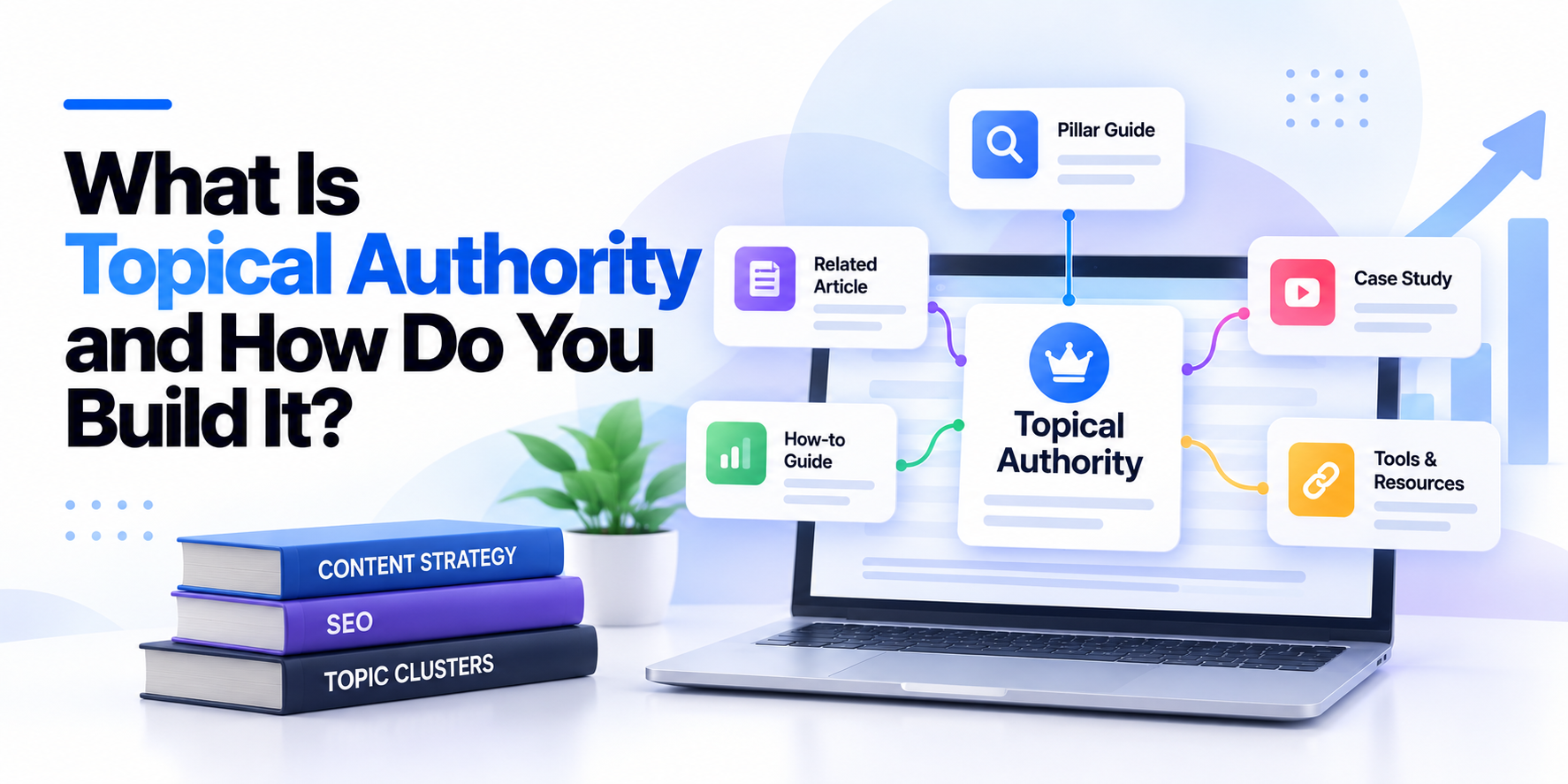
Topic clusters are the structural framework through which topical authority is built. Understanding this architecture is essential before you can implement a topical authority strategy effectively.
A topic cluster consists of three elements working together:
The Pillar Page
A pillar page is a comprehensive, in-depth piece of content that covers a broad core topic from every angle. It is designed to be the definitive resource on that topic, the page your audience would bookmark as the best single reference on the subject. Pillar pages are typically long-form (3,000 to 8,000 words), address every major aspect of the topic at a high level, and link out to the cluster articles that cover individual subtopics in more detail.
Cluster Content
Cluster content consists of individual articles or pages that each cover a specific subtopic related to the pillar in thorough depth. Where the pillar page covers the broader topic at a high level, each cluster article dives deep into one particular aspect of it. Each cluster article links back to the pillar page and links to other related cluster articles where a genuine semantic relationship exists.
Internal Linking
The internal links connecting pillar pages to cluster articles, and cluster articles to each other, are what communicate the cluster’s structure to Google. Without this linking architecture, you simply have a collection of independent articles. With it, you have a content ecosystem that signals to Google the semantic relationships between your pages and demonstrates that your website covers the topic as a coherent, interconnected whole.
To make this concrete, here is an example of what a topic cluster looks like for a digital marketing agency. The pillar page covers SEO comprehensively. The cluster articles cover: what is keyword research, how to do on-page SEO, what is link building, what is technical SEO, local SEO guide, how to use Google Search Console, what is E-E-A-T, how to build topical authority, and what is schema markup. Each cluster article links back to the pillar, and the pillar links to every cluster article. Google sees a coherent knowledge network on SEO, and recognises the site as an SEO authority.
How to Build Topical Authority: A Step-by-Step Process
Building topical authority is not a content volume play, it is a content architecture play. Here is the step-by-step process to do it correctly:
- Choose your core topic areas. This is the most important decision in the entire process. Pick three to five broad subject areas that are directly relevant to your business and that you have genuine expertise in. For a digital marketing agency, these might be SEO, PPC advertising, web design, social media marketing, and content marketing. Crucially, resist the temptation to go wide. A scattered website that covers too many unrelated subjects builds authority in none of them. Focus is the foundation of topical authority.
- Map your topic clusters. For each core topic, brainstorm every subtopic, question, comparison, and angle that your target audience might search for. Use Google’s People Also Ask boxes, your own keyword research tools, Reddit and forum discussions, and questions your existing clients have asked you. You want to be exhaustive, the goal is to find every gap before your competitors do. Group your subtopics logically around each pillar topic.
- Audit your existing content. Before creating anything new, map your existing blog posts and pages to the topic cluster structure you have planned. You will almost certainly find orphaned content that is not linked to anything, duplicate-intent articles competing with each other for the same queries, and useful pieces that simply need to be updated and connected. Do not delete duplicates, consolidate them first.
- Create your pillar page. Build the pillar page for each core topic before creating new cluster articles. The pillar anchors the cluster’s topical signal, cluster articles without a connected pillar produce weaker authority signals than those in a properly structured cluster. A minimum viable topic cluster has one pillar page plus at least four to nine cluster articles.
- Create cluster content for every subtopic. Work through your subtopic map systematically, creating thorough, genuinely helpful content for each one. Match content depth to search intent, not to an arbitrary word count. A question with a simple answer does not need 3,000 words. A complex, multi-faceted topic might need 5,000. Quality and relevance always come before volume.
- Build your internal linking architecture. Every cluster article must link back to the pillar page. The pillar page must link to every cluster article. Between cluster articles, add internal links where a genuine semantic relationship exists, but do not force links where no real connection applies. Semrush research shows that 25% of web pages have zero incoming internal links, essentially invisible to search engines. Do not let your content fall into this category.
- Update and expand your content consistently. A content cluster is not a one-time project. Clusters that stop growing eventually lose ground to competitors who keep building. Set a schedule to review and update older articles, expand coverage where gaps emerge, and add new cluster articles as your audience’s questions evolve. Google rewards freshness and sustained investment in a topic over time.
How Many Articles Do You Need to Build Topical Authority?
This is one of the most common questions about topical authority, and the honest answer is that there is no magic number. A minimum viable topic cluster is generally considered to be one pillar page plus four to nine cluster articles. But what matters far more than the number of articles is the quality and coverage of what you publish.
The right question is not how many articles do I need but rather does my content comprehensively cover the topic from every angle my audience cares about? If someone with a genuine question about your topic area visits your website, can they find a thorough, helpful answer to every reasonable question they might have? If the answer is no, those gaps represent your highest-priority content opportunities.
In terms of timeline, building meaningful topical authority typically takes three to six months of consistent, structured content production. You will begin to see early signals, ranking for long-tail variations you have not directly targeted, increased crawl frequency from Google, and gradual ranking improvements for cluster articles, before the full authority effect is visible in your analytics. Authority compounds over time: the longer you invest in a topic cluster, the stronger the signal becomes and the more easily new content within that cluster ranks.
The Role of Internal Linking in Topical Authority
Internal linking is the backbone of topical authority. You can publish the most comprehensive content in your industry, but if your pages are not connected to each other through a logical, strategic internal linking structure, Google cannot see the relationships between them. The result is a collection of isolated articles rather than a coherent knowledge network.
The hub-and-spoke model is the most effective internal linking structure for building topical authority. Every cluster article links back to the pillar (the hub). The pillar links out to every cluster article (the spokes). Where genuine semantic relationships exist between cluster articles, those are linked to each other as well. This creates a mesh of interconnected content that communicates to Google exactly how your pages relate to each other and to your core topic.
Anchor text matters too. When linking between pages, use descriptive anchor text that clearly signals what the destination page is about, for example, linking on the phrase “local SEO guide” to your local SEO pillar page, rather than generic phrases like “click here” or “read more”. Descriptive anchor text reinforces the semantic signal of your internal links and helps Google understand the relevance of the connection.
One of the most practical actions you can take right now is to audit your existing content for internal linking gaps. In Google Search Console, identify your most valuable pages and check how many other pages on your site link to them. Any important page with very few internal links pointing to it is an opportunity, find related pages across your site and add contextual links.
Topical Authority and E-E-A-T: How They Connect
Topical authority and E-E-A-T, Google’s framework for evaluating Experience, Expertise, Authoritativeness, and Trustworthiness, are deeply interconnected. In fact, building topical authority is one of the most effective ways to strengthen your E-E-A-T signals at scale.
A website that has built deep topical authority in its niche is demonstrating Expertise and Authoritativeness through the sheer breadth and depth of its coverage. But topical authority alone is not enough, Google also needs to be able to attribute that expertise to credible, identifiable individuals and organisations. This is where your E-E-A-T signals come in.
Make sure every piece of content in your clusters is attributed to a named author with a detailed bio that includes their credentials, professional background, and areas of expertise. Your About page should clearly explain who your team is, how long you have been in business, and why customers can trust you. Case studies and original research that document real-world results demonstrate Experience, the first E in E-E-A-T, in a way that no amount of well-written generic content can replicate.
Think of it this way: topical authority builds Google’s confidence that your website is the right source for a subject. E-E-A-T builds Google’s confidence that the people behind your website are genuinely qualified to speak on it. Together, they create an exceptionally strong foundation for sustained search visibility.
Topical Authority in 2026: What Has Changed?
Topical authority has always been a meaningful SEO concept, but 2026 has elevated it to a position of central importance. Several converging developments have made it the primary differentiator between websites that rank effortlessly and those that struggle despite publishing good content.
Google’s Helpful Content System, now integrated directly into its core ranking algorithm rather than running as a separate layer, has made topicality a permanent ranking factor. The system specifically penalises what it describes as a-bit-of-everything content: generalist websites that cover many loosely related subjects with low depth on any of them. Sites with focused, deep topic coverage consistently outperform scattered content strategies under this system.
The rise of AI-powered search has created an entirely new dimension to topical authority. Google’s AI Overviews, ChatGPT search, and Perplexity all use topical authority as a primary signal when deciding which websites to cite in AI-generated answers. In 2026, citations in AI Overviews are considered the top metric for measuring topical authority, and websites that have invested in deep, structured content coverage are significantly more likely to appear in these high-visibility, high-trust placements.
The competitive opportunity this creates is significant. Most businesses are still not approaching content strategically. The majority of websites publish blog posts reactively, chasing trending keywords rather than systematically building topical depth. For businesses that commit to the pillar-and-cluster model now, the compound advantage over less strategic competitors grows with every article published.
Common Topical Authority Mistakes Businesses Make
Understanding what not to do is just as important as knowing the right approach. Here are the most common mistakes that prevent businesses from building topical authority:
- Writing about too many unrelated topics. Scattered content across unrelated subjects actively weakens topical authority. Define a clear, narrow topical domain and build all your content consistently within it. Publishing a blog post about industry news one week and a recipe the next destroys the topical signal you are trying to build
- Publishing content without a cluster structure. Isolated blog posts targeting individual keywords, with no pillar page, no cluster architecture, and no internal linking strategy, produce significantly weaker authority signals than the same content organised into a coherent cluster
- Ignoring internal linking. Without the internal link mesh connecting your cluster, Google cannot see the structure you have built. Orphaned content with no internal links pointing to it is essentially invisible to search engines
- Publishing thin content to fill gaps. Creating 600-word generic articles just to tick off subtopics does more harm than good. Shallow cluster content signals the opposite of expertise. If you cannot produce genuinely helpful, substantive content on a subtopic, skip it until you can
- Not updating older articles. Authority decays when topics evolve and your content does not. Schedule regular content reviews and update older articles with current information, new statistics, and expanded coverage as your knowledge of the topic deepens
- Expecting results too quickly. Topical authority builds over months, not weeks. The SEO impact of a well-structured content cluster is cumulative, each new piece of content strengthens the authority signal of everything around it. Businesses that abandon their strategy after two months before the compounding effect kicks in miss out on the full benefit
Ready to Build Topical Authority for Your Business?
Topical authority is the SEO strategy that compounds. Every piece of content you add to a well-structured cluster makes everything around it stronger. Every month of consistent, strategic content production widens the gap between your website and competitors who are still publishing in isolation. The businesses that invest in it now are building an advantage that will be extraordinarily difficult for late-movers to close.
At Spider Web Solutions, we help businesses build the kind of content ecosystems that Google rewards, structured around genuine expertise, built with a clear topic cluster architecture, and optimised for both traditional search and AI-powered discovery. With 15+ years of experience delivering web design and development solutions, and a team of specialists across SEO, PPC, content marketing, and digital strategy, we understand what it takes to build sustainable search visibility in 2026 and beyond.
Whether you need a full content strategy built around topical authority, an SEO audit to identify where your current content falls short, or an expert team to produce the cluster content that drives your rankings forward, get in touch with Spider Web Solutions today.